Shannon ciphers, one-time pads, and perfect secrecy
- •
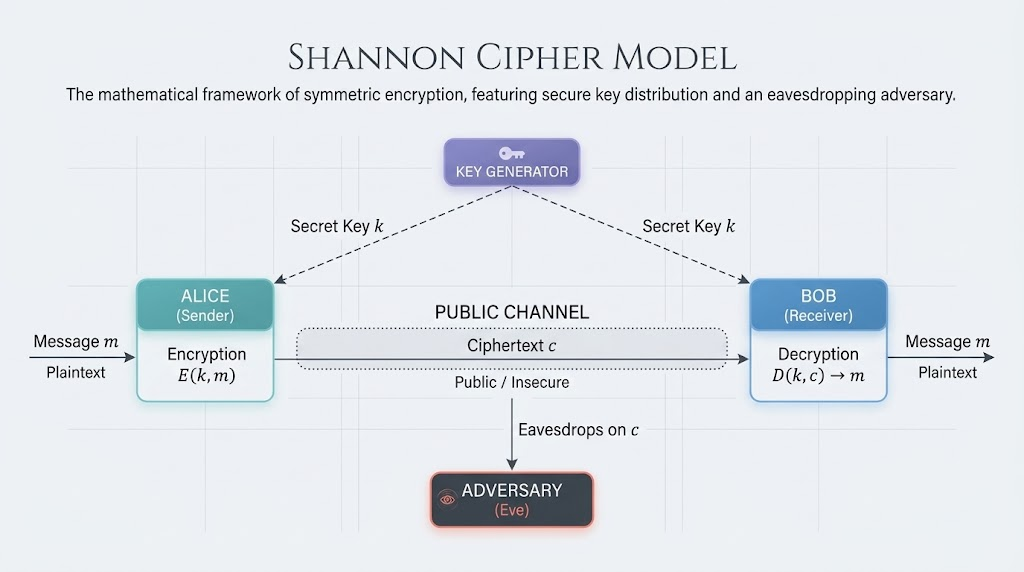
Formal Shannon ciphers
- •
The One-Time Pad (Vernam 1917)
- •
- •
- •
- •
OTP variants
- •
Variable-length pad -> keys of fixed length , messages up to length encrypted with a truncated key prefix. This variant leaks plaintext length because , violating perfect security.
- •
Additive OTP -> defined over integers using addition modulo : and . Perfectly secure.
- •
Multiplicative OTP -> defined over field for prime using modular multiplication: and . Perfectly secure.
- •
- •
- •
Practical limitations
- •
Key distribution dilemma -> the secret key must be as long as the message. If a secure channel exists to transfer an -bit key, Alice and Bob could simply transmit the -bit message itself
- •
Lack of integrity -> Bit flips in the ciphertext produce direct, predictable bit flips in the decrypted plaintext (see Malleability)
- •
- •
- •
Shannon's Theorem and the limits of perfect secrecy
- •
- •
Proof by contradiction
- •
assume
- •
fix an arbitrary valid ciphertext
- •
consider the set of all possible plaintexts that can result from decrypting under all valid keys:
- •
because each key produces at most one plaintext,
- •
therefore, there exists at least one message such that
- •
for this message , it can never encrypt to under any key:
- •
however, for any message , there exists at least one key where , meaning:
- •
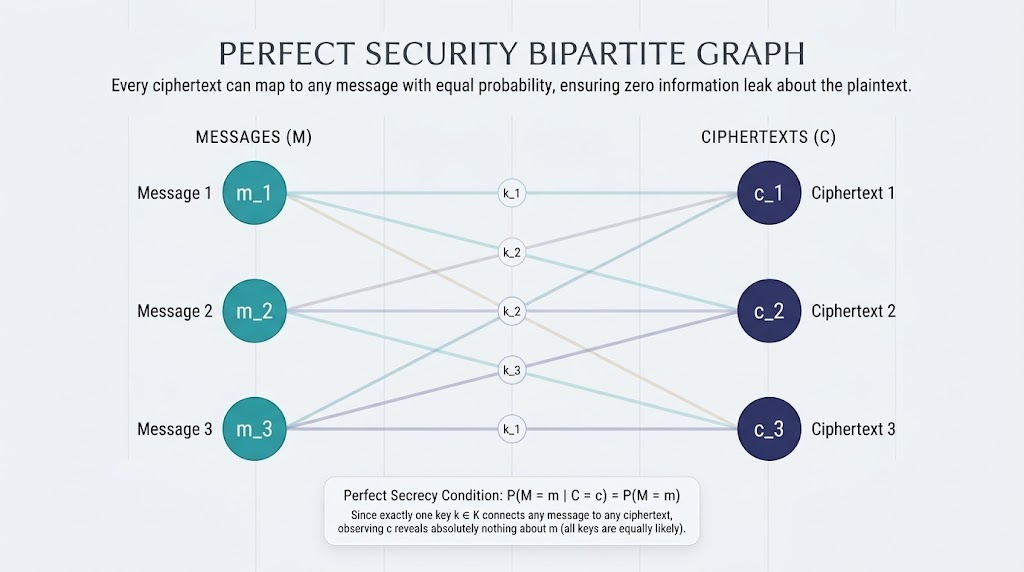
this creates an inequality , directly violating the definition of perfect security. contradiction
- •
- •
Significance for modern cryptography
- •
establishes that perfect security is practically unachievable for real-world data systems (encrypting a 10 GB database requries a pre-shared 10 GB key)
- •
derives the shift from information-theoretic security to computational ciphers, trading absolute mathematical impossibility for computational intractability against polynomial-time adversaries
- •