Requirements Elicitation
- •
def
- •
the process of actively gathering and obtaining requirements from stakeholders
- •
also known as requirements discovery or requirements gathering
- •
not just collecting stated requests, but discovering what is truly needed to support business processes or user activities — even when stakeholders cannot articulate it clearly
- •
"Elicitation is about understanding what stakeholders really need, not just what they say they want." — Wiegers & Beatty (2013)
- •
- •
importance
- •
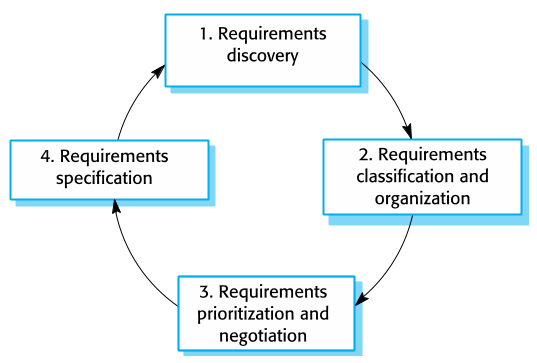
stages / process
- •
- •
requirements discovery — interacting with stakeholders to discover requirements; domain requirements are also discovered here
- •
requirements classification and organization — grouping related requirements into coherent clusters
- •
requirements prioritization and negotiation — prioritizing requirements and resolving conflicts
- •
requirements specification — documenting requirements as input to the next iteration
- •
- •
elicitation techniques
- •
interview — structured, semi-structured, or unstructured questioning sessions; see Interview
- •
- •
ethnographic study — immersing in the stakeholder's work environment over an extended period. see Ethnography (Requirements Engineering)
- •
- •
workshops / focus group discussion (FGD) — structured group discussions to gather and validate ideas collaboratively
- •
stages — choose topic → gather participants → set schedule → prepare guiding questions → reach decisions → write and distribute meeting minutes
- •
- •
document analysis — reviewing existing documents: SOPs, reports, previous project documents, regulations, organizational charts
- •
prototyping — presenting an early version or mockup of the system to users to gather feedback
- •
e.g., a UI wireframe shown to potential users, who then provide structured input
- •
- •
- •
strategy for choosing techniques
- •
use interviews for key stakeholders who hold significant domain knowledge
- •
use workshops when collaborative idea generation is needed across many parties
- •
use observation when there is a gap between what stakeholders say and what they actually do
- •
use prototyping for new features that are not yet clearly understood by stakeholders
- •
- •
common problems
- •
stakeholders don't know what they really want
- •
stakeholders express requirements in their own domain terms, not technical language
- •
conflicting requirements across different stakeholders
- •
organisational and political factors influence what requirements are surfaced
- •
requirements change during the analysis process
- •
- •
- •
Linked references 15
- Behavioral Modeling
- communication-basics-polban
- Ethnography (Requirements Engineering)
- Interview
- Interviewee Types
- Prototyping
- Prototyping (Software Process)
- Qualitative Data Synthesis (UX Research)
- Quality Function Deployment
- Requirements Analysis
- Requirements Engineering
- Scenario
- Software Project Failure
- software-analysis-and-design-polban
- Stakeholder