Computational ciphers, semantic security, and reductions
- •
Computational ciphers and effciency bounds
- •
Attack games and distinguishing advantage
- •
Attack Game methodology
- •
formal protocol between a Challenger (executes a fixed, simple verification procedure) and an Adversary (arbitrary PPT algorithm)
- •
- •
Distinguishing advantage -> measures how effectively adversary distinguishes Experiment 0 from Experiment 1:
- •
a cryptographic primitive is secure if is negligible for every PPT adversary
- •
- •
- •
- •
Negligible functions and security paramters
- •
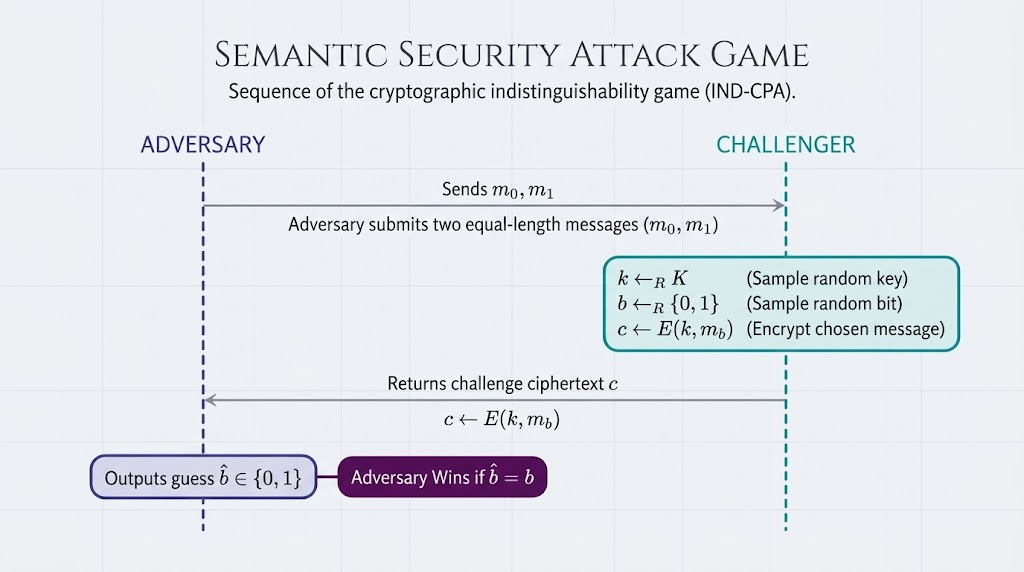
Semantic security (IND-CPA eavesdropper security)
- •
- •
Definition -> a cipher is semantically secure if for every efficient adversary :
- •
The equal-length requirement -> ciphertext is permitted to leak message length; enforcing equal length isolates confidentiality of content from length leakage
- •
Why naive security definitions fail
- •
Leakage of any single bit breaks semantic security
- •
One-Time Pad security status
- •
the One-Time Pad is semantically secure even against computationally unbounded adversaries, because and are identically distributed by the XOR Uniformity Lemma
- •
- •
- •
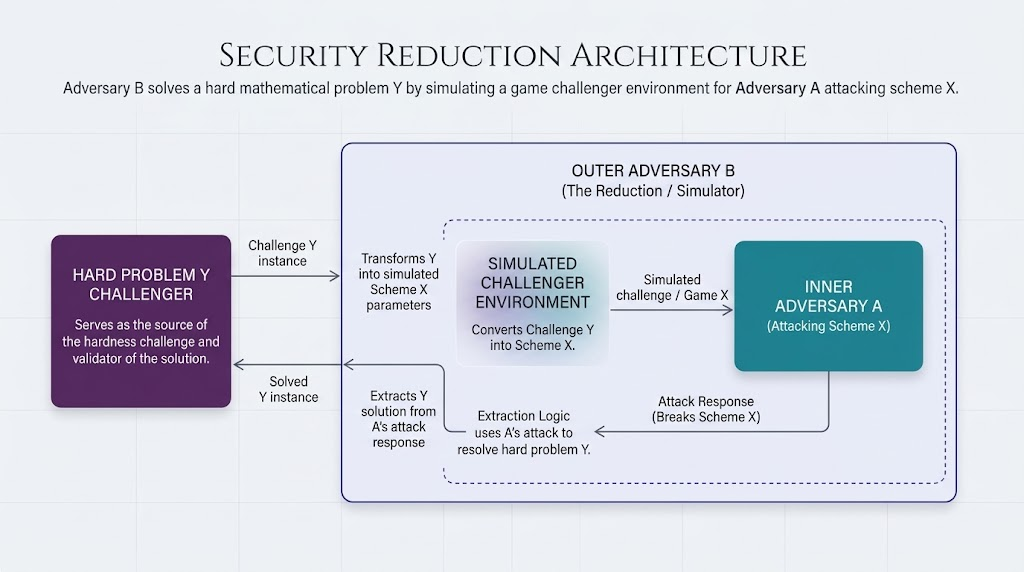
Security reductions and message recovery
- •
- •
- •
- •
Theorem: Semantic Security implies Message Recovery Security
- •
if cipher is semantically secure, then is negligible for all efficient adversaries
- •
Reduction construction
- •
build SS adversary : sample two independent uniform messages .
- •
submit to SS challenger; receive .
- •
run message recovery adversary to obtain output .
- •
if , output 0; if , output 1; otherwise, output a uniform random bit.
- •
analysis shows 's distinguishing advantage is bounded below by 's message recovery advantage:
- •
Since is negligible, must also be negligible.
- •
- •
- •
- •