Discrete random variables and distributions
- •
Random variables
- •
Random variable -> a function that maps each outcome of an experiment to a number
- •
Discrete -> takes countable values, such as ; described by a probability mass function with .
- •
is the specific value, is random variable where its value is determined from a result of a random event
- •
- •
Continuous -> takes values across an interval; probabilities come from an area under a density, and a single value has probability 0
- •
Building a discrete distribution -> list each possible value with its probability, then check that the probabilities sum to 1.
- •
for a spinner example the values have probabilities .
- •
- •
- •
Mean, variance, and expected value
- •
Binomial distribution
- •
- •
counts successes in trials, with
- •
"Success" is just a label for the coutned outcome and need not be a desirable one
- •
- •
Qualifying example -> draw a card, record whether it is an ace, replace, repeat 8 times: , , .
- •
Non-qualifying example -> rolling a die 10 times and recording the face is not binomial when the recorded value is the die number, because six outcomes are of interest rather than two.
- •
Cumulative probability -> is the sum of for ; the complement rule gives the upper tail.
- •
Mean, variance, standard deviation -> , , .
- •
Skipped-breakfast example -> 1 in 5 students skips breakfast, 10 students sampled: and .
- •
- •
Poisson distribution
- •
Hypergeometric distribution
- •
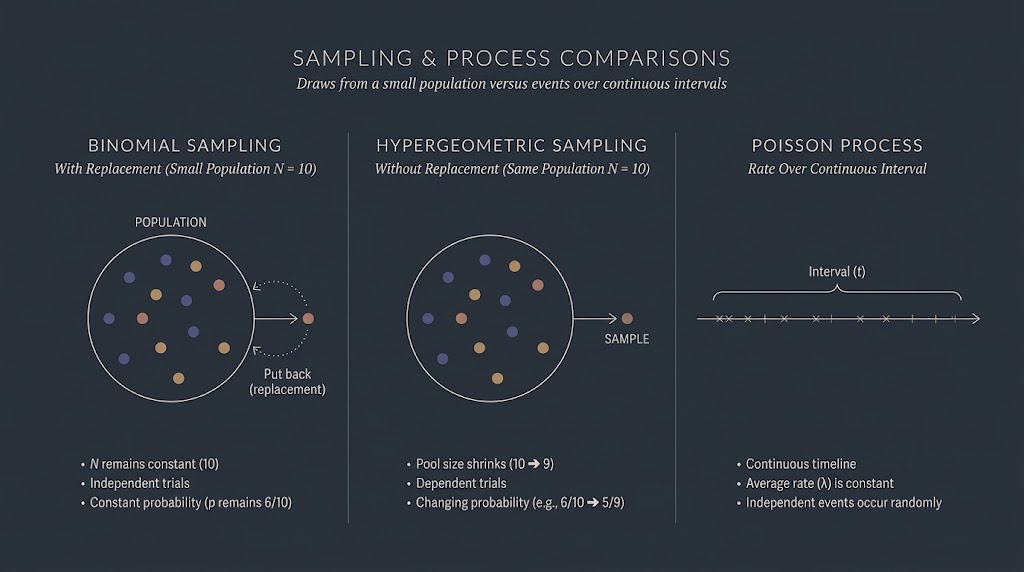
Binomial versus hypergeometric
- •
Sampling -> binomial assumes independent trials with replacement, or a large population approximating it; hypergeometric samples without replacement from a finite population.
- •
Use binomial -> when the population is large relative to the sample, or items are returned after each draw.
- •
Use hypergeometric -> when the sample is a noticeable fraction of a small population.
- •
- •
Choosing a distribution
- •
decide what is being counted.
- •
ask whether draws are with or without replacement.
- •
note wording that implies replacement, such as “returned” or “put back”.
- •
write the parameters clearly, matching the interval or population.
- •
sanity-check the result: a probability in and a mean that matches the situation.
- •
- •