Data science and classification
- •
Data science and task types
- •
Data science -> uses data to describe patterns, predict outcomes, explain evidence, or support decisions.
- •
before modeling, inspect: units, missingness, distributions, duplicates, outliers, labels, collection conditions.
- •
Outlier -> may be an error, rare valid case, or important event.
- •
Z-score -> .
- •
Supervised learning -> learns from labeled examples.
- •
Classification -> predicts categories.
- •
Regression -> predicts numeric values
- •
- •
Unsupervised learning -> finds structure without target labels, such as clustering
- •
model decision factors: data quality, evaluation, error costs, thresholds, feedback.
- •
- •
- •
- •
test
- •
- •
- •
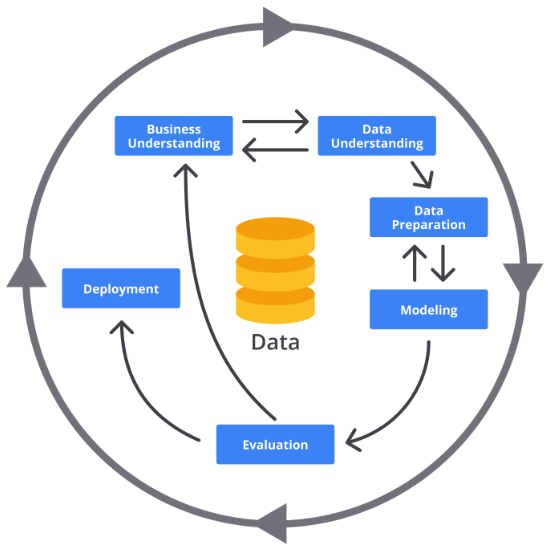
CRISP-DM: from business need to use
- •
CRISP-DM -> Cross-Industry Standard Process for Data Mining.
- •
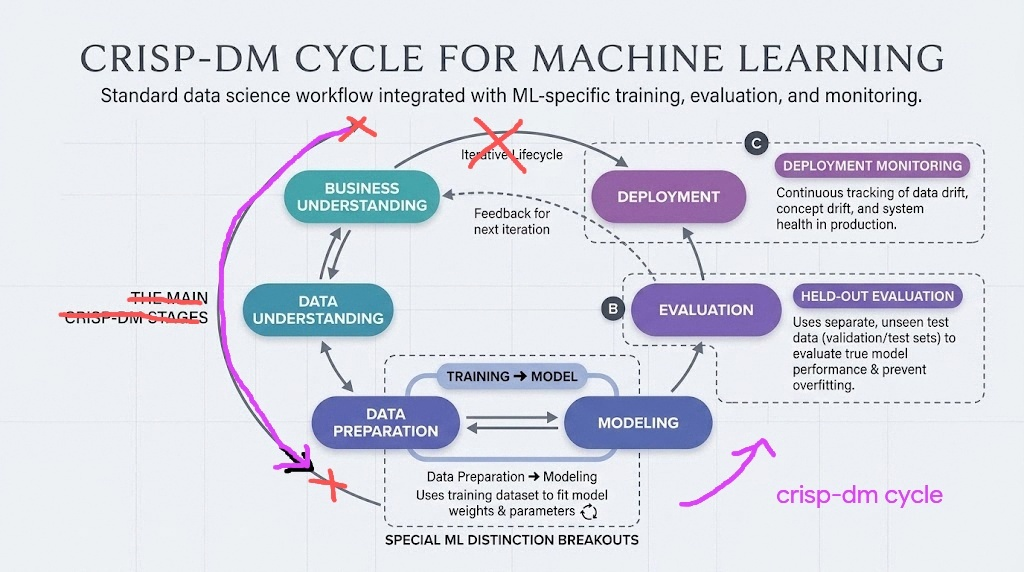
six connected phases, with iteration between them rather than a one-way checklist
- •
- •
Phases
- 1.
- 2.
- 3.
- 4.
Modeling
- 1.
choose suitable analytical or ML methods.
- 2.
define the comparison/search strategy.
- 3.
plan training and evaluation splits.
- 4.
fit candidate models and tune using validation evidence.
- 5.
Training -> training data + learning method -> fitted model.
- 6.
Evaluation data -> checks performance rather than supplying the final answer in advance.
- 1.
- 5.
- 6.
- •
- •
Related data workflows
- •
Tools -> Weka, KNIME, and R.
- •
the method and evaluation plan matter more than a particular tool.
- •
- •
- •
- •
- •
Classifiers
- •
Decision tree
- •
Linear classifier -> uses a linear decision boundary.
- •
Nonlinear classifier -> can form a more complex decision boundary.
- •
K-nearest neighbors (KNN)
- •
Naive Bayes
- •
theorem: applies Bayes' theorem
- •
- •
- •
Logistic regression -> estimates class probabilities.
- •
Support vector machine -> seeks a large-margin boundary.
- •
2D KNN sketch: plot and its three nearest neighbors, label distances/classes, and mark the predicted class.
- •
- •